Getting Started
This guide will help you set up the PageSpeed Insights MCP server and connect it to your MCP client (Claude Desktop, Cursor, Codex, Grok, etc.).
Prerequisites
Before you begin, ensure you have the following:
- Node.js: Version 20.19.0 or higher (
node -v). - Google API Key: Required to access the PageSpeed Insights API.
Obtaining a Google API Key
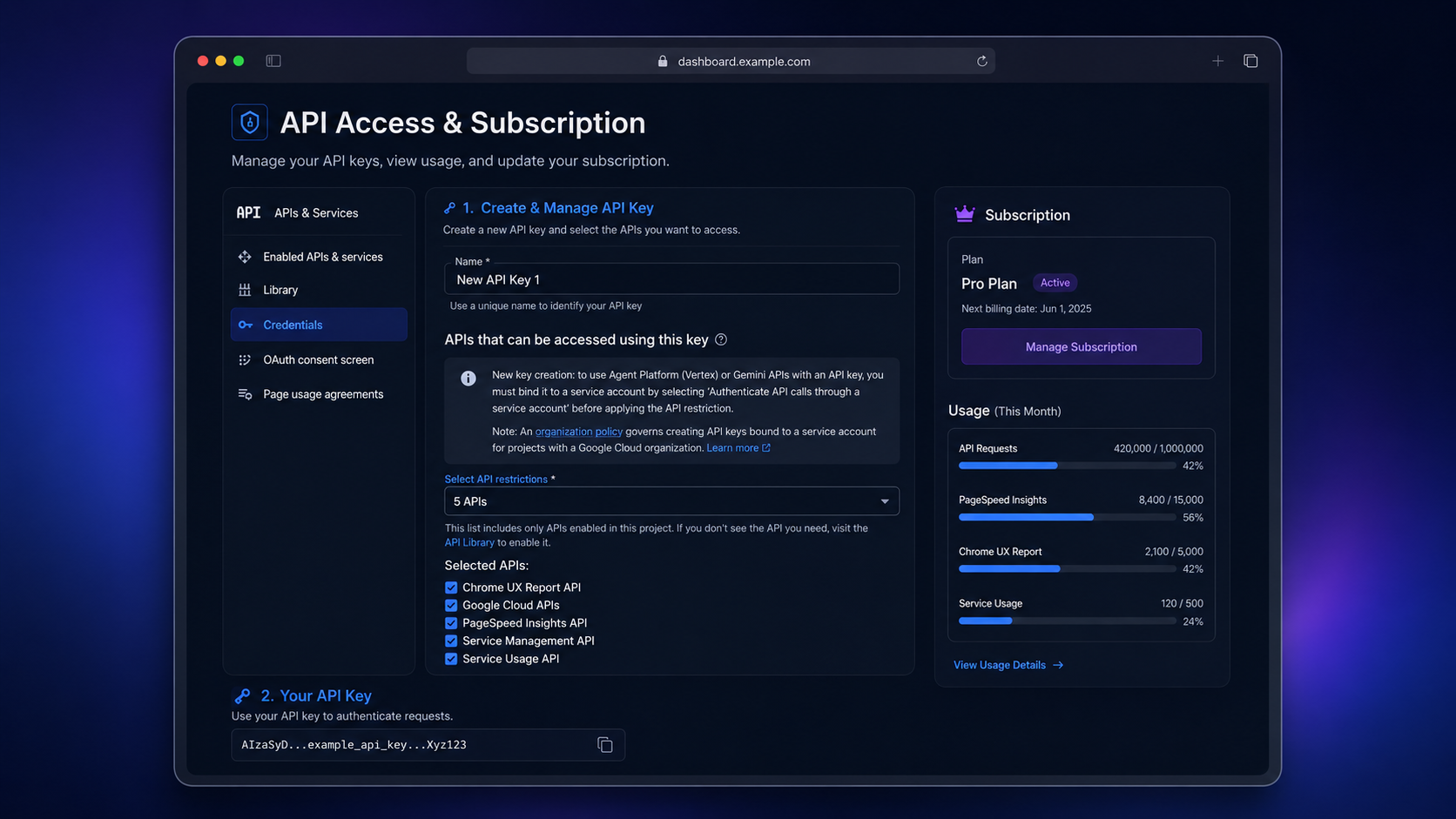
To use the PageSpeed Insights MCP server, you need a Google API key with the PageSpeed Insights API enabled.
⚡ Quick Setup Link
You can go directly to the Google Cloud Credentials Setup Page to quickly create or manage API keys in your project.
Step-by-Step Guide
- Go to the Google Cloud Console (or use the Quick Setup Link).
- Create a new project or select an existing one.
- Navigate to APIs & Services > Library.
- Search for "PageSpeed Insights API" and click Enable.
- Go to APIs & Services > Credentials.
- Click Create Credentials > API Key.
- Copy the generated key.
Installation & Running
You can run the server using npx (recommended), install it globally via npm, or use Docker.
Option 1: Using npx (Recommended)
You can run the server directly without manual installation:
export GOOGLE_API_KEY=your-google-api-key
npx -y -p pino-pretty -p pagespeed-insights-mcp pagespeed-insights-mcp
Option 2: Global Installation
Install the package globally using npm:
Then run it:
Option 3: Docker
Build and run the container:
docker build -t pagespeed-insights-mcp .
docker run -e GOOGLE_API_KEY=your-key pagespeed-insights-mcp
Configuration
The server is configured via environment variables.
| Variable | Description | Required | Default | Valid Values |
|---|---|---|---|---|
GOOGLE_API_KEY | Your Google PageSpeed Insights API Key | Yes | — | Non-empty string |
LOG_LEVEL | Logging level | No | info | trace, debug, info, warn, error, fatal |
MAX_CONCURRENCY | Maximum concurrent requests | No | 3 | 1 – 10 |
REQUEST_TIMEOUT | HTTP request timeout in milliseconds | No | 30000 | 1000 – 60000 |
RETRY_ATTEMPTS | Network failure retry attempts | No | 3 | 0 – 5 |
CACHE_TTL | Cache time-to-live in seconds | No | 3600 | 60 – 86400 |
NODE_ENV | Runtime environment | No | development | development, production, test |
Connecting to MCP Clients
Claude Desktop
Edit your claude_desktop_config.json:
- macOS:
~/Library/Application Support/Claude/claude_desktop_config.json - Windows:
%APPDATA%\Claude\claude_desktop_config.json - Linux:
~/.config/claude/claude_desktop_config.json
{
  "mcpServers": {
    "pagespeed-insights": {
      "command": "npx",
      "args": [
        "-y",
        "-p",
        "pino-pretty",
        "-p",
        "pagespeed-insights-mcp",
        "pagespeed-insights-mcp"
      ],
      "env": {
        "GOOGLE_API_KEY": "your-google-api-key-here"
      }
    }
  }
}
Codex / OpenAI / Cursor
Add to your MCP configuration (TOML):
[mcp_servers.pagespeed-insights]
command = "npx"
args = [
  "-y",
  "-p",
  "pino-pretty",
  "-p",
  "pagespeed-insights-mcp",
  "pagespeed-insights-mcp"
]
env = { GOOGLE_API_KEY = "your-google-api-key-here" }
Grok Build (config.toml)
Add to ~/.grok/config.toml (global) or <repo>/.grok/config.toml (project-scoped):
[mcp_servers.pagespeed-insights]
command = "npx"
args = ["-y", "-p", "pino-pretty", "-p", "pagespeed-insights-mcp", "pagespeed-insights-mcp"]
env = { GOOGLE_API_KEY = "${GOOGLE_API_KEY}" }
enabled = true
After updating the configuration, restart your client. The PageSpeed Insights tools will now be available in your sessions.
Usage Examples
Once connected, your AI client has access to the six v2 tools:
- Audit a site:
"Analyze https://example.com and show the top recommendations for mobile."
(Callspagespeed_analyze_page) - Diagnose render blockers:
"What CSS or JS files are blocking rendering on https://example.com?"
(Callspagespeed_diagnose_pagewithfocus="render-blocking") - Check real-user Core Web Vitals:
"Check real-user CrUX field data for https://example.com across mobile devices."
(Callspagespeed_get_field_data) - Compare environments:
"Compare performance between https://staging.example.com and https://example.com."
(Callspagespeed_compare_pageswithmode="pages") - Track regression against baseline:
"Record a baseline for https://example.com with 3 runs, then verify if our new changes caused a regression."
(Callspagespeed_compare_pageswithmode="baseline")